After years of servicing HVAC systems across Sanford, we've noticed a pattern: homeowners often wait until their AC fails completely in July before considering replacement—right when demand peaks and scheduling gets tight. That reactive approach typically costs more and leaves families uncomfortable during the worst possible time.
Here's what our experience in Central Florida has taught us: Sanford's year-round humidity and 8+ months of cooling demand push systems harder than national averages suggest. A unit rated for 15 years elsewhere often shows serious wear by year 10 here. We've seen homeowners save thousands by replacing strategically rather than waiting for emergency breakdowns.
This guide shares what we've learned from countless installations and consultations with Sanford residents—practical insights on timing your replacement, choosing efficiency ratings that actually pay off in our climate, and maximizing rebates that many homeowners don't realize they qualify for.
Quick Answers
HVAC Replacement in Sanford
What it costs: $5,000–$12,000 depending on system efficiency, home size, and ductwork condition.
Best time to replace: October through March. Off-season scheduling saves 10-15% and gives you better contractor options.
Minimum efficiency we recommend: 16 SEER or higher. Sanford's 8+ months of cooling demand means higher efficiency pays back faster here than national averages suggest.
Permits required: Yes. The city of Sanford requires mechanical permits for all HVAC replacements. Your licensed contractor handles this—if they suggest skipping it, find another contractor.
Available incentives:
Duke Energy rebates: up to $1,000
Federal tax credits: up to $2,000 (expires December 31, 2025)
Our experience: The homeowners who get the best results plan ahead, verify contractor licenses through Florida DBPR, and prioritize proper installation over chasing the highest SEER number. A well-installed 16 SEER system outperforms a poorly installed 20 SEER system every time.
Top Takeaways
Timing beats panic. Off-season replacement (October–March) saves 10-15%. You get better pricing and better contractor options.
Installation quality trumps SEER ratings. Properly installed 16 SEER outperforms poorly installed 20 SEER. Bad installation erases up to 30% of efficiency gains.
Florida's climate demands more efficiency. Sanford homeowners pay nearly double the national average for cooling. Higher SEER pays back faster here.
Check ducts before buying equipment. Leaky ductwork wastes 20-30% of conditioned air. Duct sealing often beats equipment upgrades for ROI.
Incentives expire. Duke Energy rebates: up to $1,000. Federal tax credits: up to $2,000.
Finding the Right Balance for Your Sanford Home
The comfort-versus-cost decision comes down to timing and efficiency selection. We've found that Sanford homeowners who replace proactively during the off-season—late fall through early spring—typically save 10% to 15% compared to emergency summer installations when demand peaks and contractor availability shrinks. That savings cushion often allows upgrading to a more efficient unit without stretching the budget.
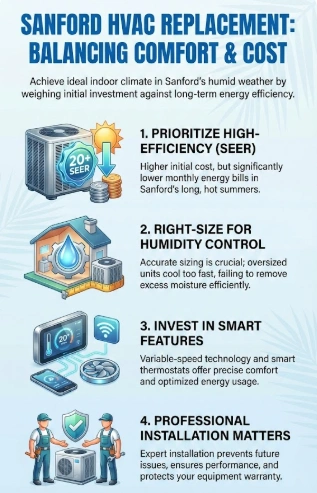
Efficiency ratings matter more here than in milder climates. With eight-plus months of cooling demand annually, the jump from a 14 SEER to 16 SEER system pays back faster in Central Florida—often within three to four years through lower electricity bills. Variable-speed compressors add upfront cost but control Sanford's persistent humidity far better, reducing that clammy feeling without constantly lowering your thermostat.
The true cost equation extends beyond equipment price. Ductwork condition, electrical panel capacity, and available rebates from Duke Energy and federal tax credits all factor into your final investment. We advise homeowners to request itemized quotes and verify current incentive programs before signing—many leave money on the table simply by not asking.
"After installing thousands of systems across Central Florida, we've learned that the homeowners who get the best long-term value aren't the ones who buy the cheapest unit or even the most expensive one—they're the ones who match the right efficiency level to our climate and time their purchase strategically."
Essential Resources for Sanford HVAC Replacement Decisions
Save Up to $1,000 With Duke Energy Rebates
After working with countless Sanford homeowners on system replacements, we always point them to Duke Energy's rebate program first. Completing the free Home Energy Check unlocks real savings—and we've seen customers reduce their out-of-pocket costs significantly by taking this step before scheduling installation.
Source: Duke Energy Home Energy Improvement Program URL: https://www.duke-energy.com/home/products/home-energy-improvement
Claim Up to $2,000 in Federal Tax Credits
Customers frequently ask us whether their new system qualifies for tax credits—and the answer matters. The IRS allows up to $2,000 back on qualifying heat pumps or $600 on central AC units installed through December 31, 2025. We recommend bookmarking this page and discussing eligibility with your contractor before signing any agreement.
Source: Internal Revenue Service URL: https://www.irs.gov/credits-deductions/energy-efficient-home-improvement-credit
Verify Your Contractor's Florida License Instantly
Here's something we tell every homeowner: never sign a contract without checking the DBPR database first. Florida requires valid state certification for all HVAC installations, and a two-minute search protects you from unlicensed operators who cut corners. We've heard too many stories from customers who learned this lesson the hard way.
Source: Florida Department of Business and Professional Regulation URL: https://www.myfloridalicense.com
Apply for Sanford Building Permits Online
Permits aren't optional—Sanford requires mechanical permits and inspections for every HVAC replacement. The city's online portal makes the process straightforward, and any reputable contractor will handle this for you. If someone suggests skipping the permit, that's a red flag we'd take seriously.
Source: City of Sanford Building Division URL: https://sanfordfl.gov/government/development-services/building-division/
Understand Efficiency Ratings That Matter in Florida
Based on our experience in Central Florida, efficiency ratings deserve more attention than most homeowners give them. ENERGY STAR's guide breaks down SEER ratings, installation best practices, and duct sealing—all factors that directly impact your comfort and energy bills in our cooling-heavy climate.
Source: U.S. Environmental Protection Agency / ENERGY STAR URL: https://www.energystar.gov/saveathome/heating-cooling
Improve Indoor Air Quality With Proper HVAC Selection
Customers tell us humidity control ranks just as high as cooling power on their priority list—and for good reason. The EPA's indoor air quality resources explain how MERV-rated filtration and proper ventilation work together to manage Florida's moisture challenges and keep allergens in check.
Source: U.S. Environmental Protection Agency URL: https://www.epa.gov/indoor-air-quality-iaq
Confirm Equipment Qualifies for Tax Credits Before You Buy
We always recommend verifying tax credit eligibility before finalizing any equipment selection. ENERGY STAR's product finder lets you search by manufacturer and model number—five minutes of research that could save you hundreds at tax time.
Source: U.S. Environmental Protection Agency / ENERGY STAR URL: https://www.energystar.gov/about/federal-tax-credits
Supporting Statistics
Why We Push Back When Contractors Rush Installation
We've watched too many Sanford homeowners pay for high-efficiency systems that never deliver promised savings. The reason almost always traces back to installation shortcuts.
Research from the National Institute of Standards and Technology confirms what we've observed:
Improper installation increases heating and cooling energy use by roughly 30%
Top culprits include refrigerant undercharge and incorrectly sized ductwork
A poorly installed 18 SEER system can perform worse than a properly installed 14 SEER unit
Bottom line: The contractor matters as much as the equipment itself.
Source: National Institute of Standards and Technology (NIST) URL: https://www.nist.gov/news-events/news/2014/11/underperforming-energy-efficiency-hvac-equipment-suffers-due-poor
The Real Cost of Cooling in Central Florida
When we explain why efficiency upgrades pay off faster here than national calculators suggest, the data backs us up.
U.S. Energy Information Administration findings for hot-humid regions like Sanford:
Average annual AC cost: $525 (vs. $265 national average)
Cooling share of energy bills: 27% (vs. 12% nationally)
Potential savings from 14 SEER to 16 SEER upgrade: $150+ annually
Bottom line: In our climate, efficiency gains compound quickly over a system's 15-year lifespan.
Source: U.S. Energy Information Administration (EIA) URL: https://www.eia.gov/todayinenergy/detail.php?id=36692
What We Check Before Recommending New Equipment
One of the first things we inspect on any replacement consultation is the ductwork—and there's a reason.
ENERGY STAR findings on typical home duct systems:
20–30% of conditioned air escapes through leaks, holes, and poor connections
Sealing and insulating ducts can boost efficiency by 20% or more
Duct repairs often deliver better ROI than jumping to the highest SEER rating
Bottom line: We've walked into houses where new systems failed to fix hot spots and humidity because nobody addressed the ducts first.
Source: U.S. Environmental Protection Agency / ENERGY STAR URL: https://www.energystar.gov/products/ask-the-experts/how-keep-your-hvac-system-working-efficiently
Final Thought & Opinion
Our Take on HVAC Replacement in Sanford
After years of working with Central Florida homeowners, we've reached a conclusion that might surprise you: the biggest mistake isn't buying the wrong system—it's buying at the wrong time with the wrong contractor.
The pattern we see every summer:
Homeowner waits until AC fails in July
Panic sets in, temperatures rise, patience drops
First available contractor gets the job
Prices climb, corners get cut, permits get skipped
We've watched it happen hundreds of times.
What the smartest homeowners do differently:
Plan replacements during the off-season (late fall through early spring) when contractors compete for business
Verify licenses, check references, and get itemized quotes before signing
Prioritize proper installation and duct assessment over chasing the highest SEER number
The math that matters:
Federal tax credits and Duke Energy rebates can total $2,000+
Improper installation erases up to 30% of those efficiency gains
Leaky ductwork in a 140-degree attic undermines even premium equipment
Our honest opinion:
A 16 SEER system with proper installation, sealed ductwork, and a licensed contractor will outperform a 20 SEER system installed by the lowest bidder who skipped the permit. Every time.
The bottom line:
The comfort-versus-cost balance isn't about choosing between them. It's about making smart decisions on timing, contractor selection, and system sizing that deliver both.
Sanford homeowners who plan strategically end up more comfortable and spend less over their system's lifespan than those who panic-buy in July.
Next Steps
What to Do Now
Take these steps to position yourself for a smart replacement decision.
1. Assess Your Current System
Check unit age on the outdoor condenser label
Note recurring issues: uneven cooling, humidity, frequent cycling
Review past 12 months of energy bills for unusual spikes
2. Complete Duke Energy's Free Home Energy Check
Required for rebates (up to $1,000 back)
Valid for 24 months—complete now even if replacement is a year out
3. Verify Contractor Credentials
Search Florida DBPR database for active license status
Confirm insurance coverage and local references
4. Get 2-3 Itemized Quotes
Each quote should include:
Equipment cost, brand, model, SEER rating
Labor, installation, and permit fees
Ductwork assessment and repair recommendations
Warranty terms (equipment and labor)
5. Confirm Tax Credit Eligibility
Verify equipment qualifies via ENERGY STAR product finder
Save documentation for IRS Form 5695
6. Time Your Replacement
Best: October through March
Avoid: June through August
Plan ahead: System 10+ years old? Start gathering quotes now
7. Confirm Permits
Sanford requires mechanical permits for all HVAC replacements
Your contractor handles this—if they suggest skipping, walk away
FAQ on "HVAC Replacement in Sanford"
Q: How much does HVAC replacement cost in Sanford?
A: Based on what we see in Central Florida, most Sanford homeowners invest between $5,000 and $12,000. Final cost depends on:
Equipment efficiency rating
Home size and layout
Ductwork condition
Installation complexity
We've watched customers recoup higher SEER costs within 3-4 years given our year-round cooling demands. Don't overlook available incentives:
Duke Energy rebates: up to $1,000
Federal tax credits: up to $2,000
Too many homeowners leave this money on the table simply because they didn't ask.
Q: Do I need a permit for HVAC replacement in Sanford?
A: Yes—non-negotiable in our book.
What you need to know:
City of Sanford requires mechanical permits for all HVAC replacements
Inspections scheduled through the Citizenserve portal
Your contractor handles the process, not you
Our honest advice: If any contractor suggests skipping the permit, walk away. We've talked to homeowners who learned the hard way:
Unpermitted work voids warranties
Creates code violations
Kills deals when selling your home
The permit exists to protect your investment.
Q: What SEER rating should I choose for Sanford's climate?
A: After years in Central Florida, we tell Sanford homeowners to start at 16 SEER minimum.
Why the math works differently here:
National calculators don't account for 8+ months of cooling demand
14 SEER to 16 SEER upgrade typically pays back in 3-4 years
Higher efficiency compounds faster in our climate
One thing we always mention: Consider variable-speed systems if humidity bothers you. They run longer at lower capacity—controls that sticky Florida moisture far better than single-stage units cycling on and off.
Q: When is the best time to replace my HVAC system in Sanford?
A: We push customers toward October through March if their system can make it.
Off-season advantages:
Contractor schedules open up
Pricing drops 10-15%
Time to compare options without sweating through a dead AC
Summer replacement reality:
Every contractor in town is slammed
Equipment options narrow to whatever's in stock
You lose all negotiating leverage
Our advice: System showing warning signs now? Start gathering quotes before it becomes an emergency.
Q: How do I find a licensed HVAC contractor in Sanford?
A: Start with the Florida DBPR database at myfloridalicense.com. Takes two minutes. We tell every homeowner to do this first—no exceptions.
Beyond the license, verify:
Current insurance coverage
Google and BBB reviews
References from jobs in your neighborhood
What separates serious contractors from the rest: They welcome comparison.
Get itemized quotes from 2-3 companies
Anyone who pressures you to sign immediately isn't worth your business
If they won't break down pricing line by line, walk away
Here is the nearest branch location serving the Aventura FL area…
Filterbuy HVAC Solutions - Miami FL
1300 S Miami Ave Unit 4806, Miami, FL 33130
(305) 306-5027
https://maps.app.goo.gl/jkEe6CxzmpsyeKdP8