How Long 17x22x4 Air Filters Last in a Vacation Home
TL;DR
In a vacation or seasonal home, a 17x22x4 air filter usually goes 6 to 9 months between changes rather than the 3 months a full-time house needs. An empty home generates almost no occupant dust, but the HVAC keeps running to control humidity, which flips the limiting factor from dirt to moisture. Change it the day you lock up and the day you return.
Key Takeaways
6 to 9 months is the realistic interval for a part-time home. Booked rentals need 3 to 4; a dry northern house can reach 12.
Runtime and humidity set the schedule, not the calendar.
The EPA recommends indoor humidity below 60%, ideally 30% to 50%. Above 60%, the organic dust in a filter's pleats becomes a growth surface.
Nominal size is not the actual size. A 17x22x4 measures 16.5 x 21.5 x 3.63 inches, and a loose fit lets air bypass the media.
A humidity sensor protects the house better than any filter does.
How Long Can a 17x22x4 Air Filter Go in a Vacation Home?
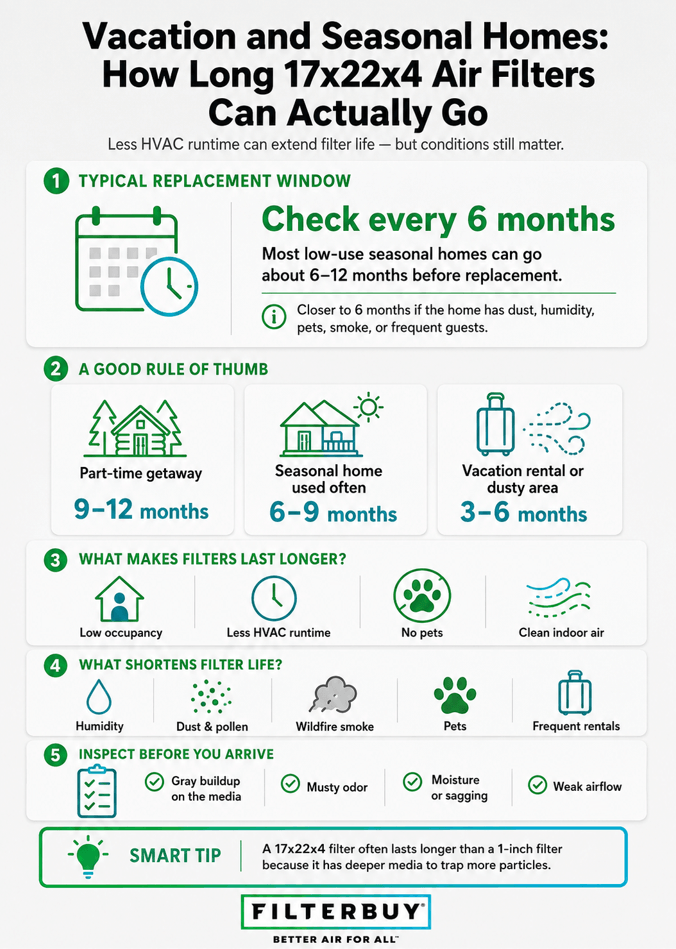
A 17x22x4 air filter in a part-time home typically lasts 6 to 9 months, compared with 3 to 6 in a full-time home. The 4-inch depth carries roughly four times the pleated media of a 1-inch filter, and a closed house produces little of the dust that actually loads one. Humidity, not dust, sets the outside limit.
Every published interval assumes somebody is living in the house. Ninety days, sixty for pets, thirty for allergies: all of it is calibrated to a home generating dust because people move around in it. What does not stop is runtime. A seasonal home is left with the air conditioning running so the house does not sit in its own moisture, so the filter gets old before it gets dirty.
Why Runtime, Not the Calendar, Sets the Change Interval
Filter life depends on how much air passes through the media and what was in it, so an unoccupied house runs on a different clock. The Air-Conditioning, Heating, and Refrigeration Institute states in its guidance on air filtration and ultraviolet light treatment that no reliable method exists for calculating filter life precisely, naming airflow and particle concentration as the real drivers. Both change when a house sits empty.
Owners get the rental row wrong most often. A heavily booked rental is a full-time home with a rotating cast.
What Humidity Does to a Filter in a Closed-Up House
Humidity ends a filter's useful life in a closed house, not dust. Pleated media holds captured organic material: pollen, skin cells, textile fiber, and mold spores, all inert while dry. In A Brief Guide to Mold, Moisture and Your Home, the EPA advises keeping indoor humidity below 60 percent and ideally between 30 and 50, because sustained moisture above that lets mold germinate on organic surfaces.
This is why "it still looks clean" is a bad reason to leave a filter in. Visual inspection tells you about loading, not about what has been growing in the pleat pack since June.
Two settings do the protective work: hold the thermostat at 78–80°F, warm enough to save money but low enough that the system still cycles and pulls moisture out, and set any humidistat to 50–55%. Turning the system off entirely is the one option that reliably causes damage.
Nominal Size Versus Actual Size, and Which MERV to Buy
A 17x22x4 is a nominal size; the filter that ships measures 16.5 x 21.5 x 3.63 inches, so it slides in without binding. Fit matters more in a house you visit twice a year, because a gap at the cabinet edge lets air bypass the pleats, and in an empty home nobody notices until the coil is dirty. If you are unsure of your size, start with this site's guide to choosing the right standard HVAC filter size.
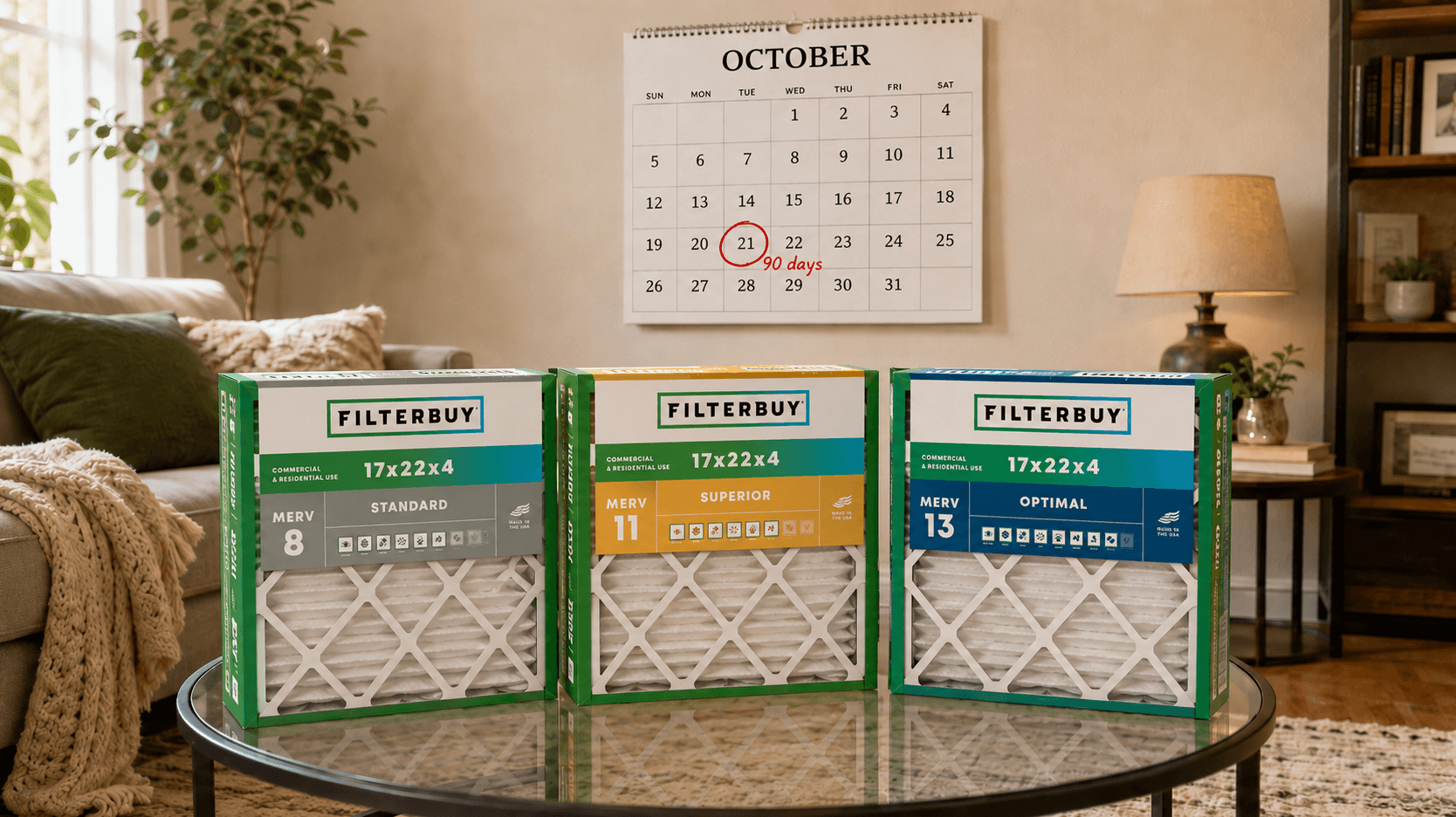
A 4-inch cabinet is the depth where MERV 13 stops being a trade-off, because the added media area offsets the higher resistance. Filterbuy's 17x22x4 MERV 13 specification puts 4-inch life at 6 to 9 months, matching the interval in this article reaches from the runtime side.
The cost spread is smaller than people assume. At roughly $33 per air filter in a six-pack, two changes a year run about $65 and four run about $130, so there is no reason to cut it fine. Spend your attention on humidity control instead, where the downside runs to thousands. (List prices September 2026.)
Does a UV Light Change How Long the Filter Lasts?
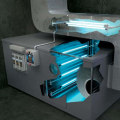
Yes. A UV-C lamp shortens filter life when aimed at the filter rather than the coil, and a seasonal home is where that matters most, because the same filter sits under the lamp for eight or nine months instead of ninety days. AHRI places UV lamps at the coil and drain pan, and warns that a lamp mounted upstream of the filter degrades the media prematurely. Non-fiberglass media, which is what a pleated 17x22x4 uses, is damaged by UV exposure. If your lamp hits the filter face, reposition it downstream or shorten the interval to match. This site covers the purifier side in case UV light destroys an air filter.
The Failure That Makes the Filter Irrelevant
If the HVAC system stops while you are away, no filter at any MERV rating changes the outcome. A system that quits in week two of a five-month absence leaves a sealed house above the EPA's 60% threshold for four months. The usual causes are a tripped breaker and a clogged condensate drain, and ENERGY STAR's maintenance checklist warns that a plugged drain causes water damage and affects indoor humidity.
So here is the recommendation that cuts against an article about air filters: if this season's budget covers either premium filtration or one connected humidity sensor, buy the sensor. A filter protects the system and the air; a sensor that texts you at 65% protects the house. Ask for the drain line to be cleared at your pre-departure service call, too, because almost nobody does.
Give whoever checks the house four instructions: smell a return vent, photograph the thermostat, look for water near the air handler, and confirm air moves from a supply vent.
"In a seasonal home, the filter rarely fails from dust. It fails from sitting in moist air, which is why we tell part-time owners to change on departure and arrival instead of counting to 90."
-The Filterbuy Team
Essential Resources
1. Confirm the Exact Dimensions Before You Order
Lists the actual 16.5 x 21.5 x 3.63 measurement alongside the MERV 8, 11, and 13 options, so you can check it against your cabinet before ordering.
Source: Filterbuy Page For Its 17x22x4 Air Filters
2. Understand What a Furnace Filter Can and Cannot Do
Explains in plain language where filtration fits alongside source control and ventilation, without the marketing found elsewhere.
Source: EPA: Air Cleaners and Air Filters in the Home
3. Learn Why Filter Life Has No Fixed Formula
The manufacturers' standards body on what actually drives filter life, and where UV lamps belong relative to the filter.
Source: AHRI: Air Filtration and Ultraviolet Light Treatment
4. Know the Humidity Number That Prevents Mold
Advises keeping indoor humidity no higher than 50% all day, the single most useful number for a house closed through a humid summer.
Source: CDC: About Mold
5. Control the Allergens That Build Up While You Are Gone
Covers dust mites, mold, and pet dander, which accumulate quietly in a closed house and hit you on arrival day.
Source: AAFA: Control Indoor Allergens
Supporting Statistics
1. Indoor Air Can Be 2 to 5 Times More Polluted Than Outdoor Air
The American Lung Association reports that indoor air can be 2 to 5 times, and occasionally up to 100 times, more polluted than the air outside, and that Americans spend 90% of their time indoors. A seasonal home concentrates that problem: you arrive and immediately spend days breathing air that has been recirculating through the same filter since spring.
Source: American Lung Association: Clean Air Indoors
2. Nearly 90% of U.S. Households Run Air Conditioning
EIA's 2020 Residential Energy Consumption Survey found 88% of U.S. households use air conditioning, rising to 93% in the South. Nearly every seasonal home there has a system cycling all summer, whether anyone is home or not, so assume runtime rather than idleness when estimating filter life.
Source: EIA: Nearly 90% of U.S. Households Used Air Conditioning in 2020
3. About 3.4 Million U.S. Homes Sit Vacant for Seasonal Use
The Census Bureau counted roughly 3.4 million housing units vacant for seasonal use in the second quarter of 2026, or 2.3% of the housing stock, all running HVAC on a schedule, for which almost no filter guidance is written.
Source: U.S. Census Bureau: Quarterly Residential Vacancies and Homeownership
Final Thoughts
The 90-day rule is the worst guidance available for a house nobody lives in. Follow it strictly, and you buy filters you did not need; ignore it, and you leave loaded media in humid air for a year.
In a seasonal house, the filter stops being a consumable and becomes a diagnostic, because it is the only component that was in the airstream for every hour you were away. Pull it in October and read it:
Dry and lightly gray. Humidity control worked. Change nothing.
Damp along the bottom edge. The system cycled but did not dehumidify enough. Drop the setpoint two degrees, shorten to six months.
Musty or spotted. You had a moisture event. Bag the filter outside and have the coil, drain pan, and drain line inspected before running the system hard. A better filter treats the wrong problem here.
Heavy dust in an empty house. Something is getting in. Check duct leaks, dampers, door seals.
Next Steps
Measure the cabinet, not the old filter. If the last one was wrong, measuring it repeats the mistake.
Pick your MERV once. MERV 11 for general use, 13 for allergy or asthma households.
Buy the six-pack. Three years of filters at roughly half the per-unit price.
Order the humidity sensor in the same cart.
Install fresh on departure, photograph it, change again on arrival.
Frequently Asked Questions
Q: Can I Leave a 17x22x4 Filter in for a Full Year?
A: In a dry climate with low runtime, sometimes. Where the AC runs all summer, no. Six to eight months is the ceiling, and the risk is microbial rather than mechanical.
Q: Should I Turn the HVAC Off While the House Is Empty?
A: No. An unconditioned house in a humid climate crosses the EPA's 60% threshold quickly, and mold can establish on damp organic surfaces within days.
Q: Should I Set Up Auto-Delivery for a House I Am Not Living In?
A: Only if you time it. Recurring shipments to a vacant property stack boxes on the porch for months, a theft risk and a signal nobody is home. Time deliveries to your arrival, or ship to your primary address.
Q: How Do I Tell a Damp Filter From a Merely Dirty One?
A: Flex a pleat. Dry media springs back and feels crisp. Media that sat in humid air feels limp and holds a crease, and that filter is overdue regardless of how it looks.
Ready to Get Your Seasonal Home on the Right Filter Schedule?
Stop counting to 90 and change your 17x22x4 filter on the two days you will never forget: the day you lock up and the day you come back. Order a Filterbuy six-pack before your next departure, and the schedule runs itself.
Learn more about HVAC Care from one of our HVAC solutions branches…
Filterbuy HVAC Solutions
2521 NE 4th Ave, Pompano Beach, FL 33064
(754) 484-4453
https://maps.app.goo.gl/JmWkEXya7uzuLzBh8